From Survival to Sustainability: Business and Professional Gains in Family Child Care following Intensive Leadership Training
BY Robyn Kelton, Nudrat Hassan, & Xiaoli Wen | April 22, 2026
This document may be printed, photocopied, and disseminated freely with attribution. All content is the property of the McCormick Institute for Early Childhood.
INTRODUCTION
Family child care (FCC) programs, operated by licensed or listed early childhood education and care (ECEC) professionals within their homes, meet the diverse economic, cultural, and logistical needs of families and communities across the country. Family Child Care (FCC) offers flexible, culturally responsive care that supports parents’ ability to work. Yet, the number of FCC programs and FCC professionals has been declining for nearly two decades (Junus et al., 2026; National Center on Early Childhood Quality Assurance, 2020).
One possible reason is that many FCC professionals open their programs with limited business training, despite serving dual roles as educators and small business owners(Kelton & Tenis, 2024a). A growing body of research highlights ongoing gaps in FCC business knowledge and capacity (Bromer et al., 2021; Kelton & Tenis, 2024a; National Center on Early Childhood Quality Assurance, 2020; Vieira & Hill, 2019). FCC professionals also report low confidence in financial management, data use, and marketing (Kelton & Tenis, 2024b). Without intentional investment in the development of FCC professionals, communities lose critical FCC options, reducing access, affordability, and stability for families.
TAKING THE LEAD
To help meet the unique needs of FCC professionals, the McCormick Institute for Early Childhood, formerly the Center for Early Childhood Leadership, at National Louis University, launched Taking the Lead (TTL). TTL is a cohort-based professional learning academy designed specifically for FCC professionals. It combines business acumen, leadership development, and advocacy skills to support sustainable FCC programs and improve the quality of care and education for children. The overarching goals of TTL are to help professionals: 1) develop strategies for growing and sustaining a thriving business, 2) improve quality practices as both business owners and educators, 3) build professional networks with other FCC professionals, and 4) deepen their understanding of their role as leaders. Since its launch in 2015, TTL has graduated 11 cohorts and nearly 200 family child care professionals in Illinois.
TTL Core Training Elements
Over a nine-month training cycle, TTL offers an FCC-specific curriculum with applied learning activities that strengthen professionals’ leadership capacity and business competencies while fostering collegial support and networking. Instructors create a GroupMe text chat for each cohort so participants can connect, network, and seek support outside monthly sessions. Each participant uses data from the Business Administration Scale for Family Child Care (BAS; Talan & Bloom, 2018) and the Family Child Care Environment Rating Scale-Revised (FCCERS-R) assessments to develop a Quality Improvement Plan (QIP) and receives a $300 grant to support implementation. At the end of TTL, each participant delivers a 10- minute presentation on the design and impact of their QIP.
A primary objective of the leadership academy is to stabilize and retain the FCC workforce by supporting professionals in demonstrating competencies aligned with the Illinois Gateways to Opportunity FCC Credential and Illinois Quality Recognition and Improvement System (QRIS) ExceleRate™ Illinois, while also fostering a sustained commitment to professional growth. Because FCC professionals serve in dual roles as educators and business owners and often work extended hours, their time is limited. TTL was intentionally developed to ensure that its 119 hours provide meaningful learning that builds knowledge and skills, supports professional recognition, and strengthens pathways to increased compensation. The program is aligned with state and national quality improvement and professional development systems. Table 1 below highlights key areas of program alignment.
Table 1
TTL Alignment with State and National Systems
| System | Demonstration of Alignment |
|---|---|
| Illinois QRIS |
|
| Illinois FCC Credential |
|
| ECEC Professional Engagement |
|
| Postsecondary Pathways |
|
THIS STUDY
This Research Note examines the extent to which TTL has achieved the following goals: 1) developing strategies for growing and sustaining a thriving business, 2) improving quality practices as both business owners and educators, 3) building networking opportunities with other FCC professionals, and 4) deepening participants’ understanding of their role as leaders. It also examines the extent to which TTL supports FCC professionals in demonstrating competencies aligned with the Illinois Gateways to Opportunity FCC Credential and ExceleRate™ Illinois, as well as in fostering a sustained commitment to professional growth.
METHODS
Sample
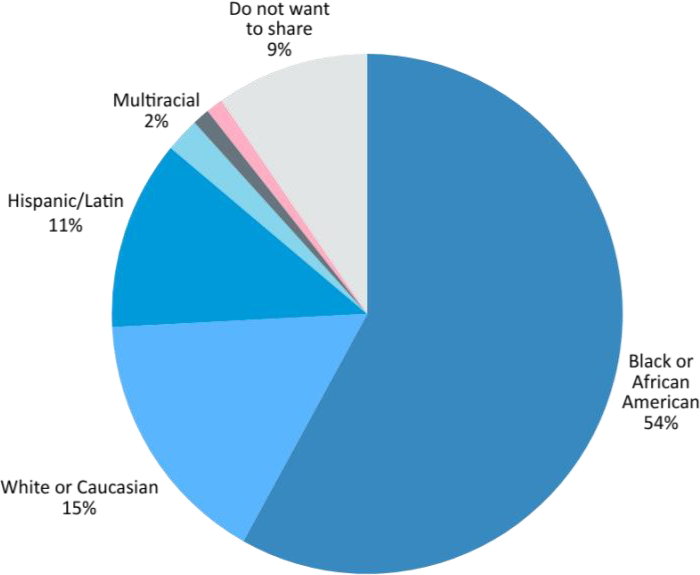
Data were collected from 196 FCC professionals who completed TTL cohorts 1 – 11 between 2014 and 2025. The participants were predominantly female, with 97% identifying as female and 3% identifying as male. Participants represented a range of racial diversity as noted in Figure 1. Ages ranged from 18 years to over 70 years old. The most commonly reported age ranges were 50-59 years old (30%) and 40- 49 years old (29%).
The majority of the participants (66%) had a college degree. Of those with degrees, 43% had an associate’s degree, 44% had a bachelor’s degree, 12% had a master’s degree, and 1% had a doctoral degree. Participants averaged 13 years of experience operating an FCC program (SD = 7.69, range 0 to 35 years). Twentysix percent of participants also had prior experience as an FCC assistant, 44% had prior experience in a center-based program, and 24% had prior experience in a public school.
Together, TTL participants served 2,069 children. On average, individual programs enrolled 11 children (range 0-31). Eighty-three percent of programs enrolled children receiving state subsidies, 75% served families of low income, and 43% enrolled children diagnosed with a special need. Ten percent of the programs received Early Head Start funding. The majority (66%) of the programs enrolled infants, 90% enrolled toddlers, 88% preschoolers, and 89% school-age. Fifty-three percent of programs offered part-day services, 58% offered evening or extended care, and 5% offered overnight care. Just over a quarter (26%) of the programs were accredited by NAFCC.
Measures
Intake Survey. An intake survey was administered electronically prior to the start of the academy to collect baseline information about participants, including their backgrounds, thoughts and feelings about their roles, and demographic data about their programs. The intake survey was administered to all cohorts.
Business Administration Scale for Family Child Care (BAS). Formal BAS assessments were used to measure changes in business practices over time (Talan & Bloom, 2018). The BAS is a valid and reliable tool that includes 10 items that measure business and professional practices in family child care programs. Each item is scored on a scale of 1 to 7, with 1 representing inadequate quality, 3 representing minimal quality, 5 representing good quality, and 7 representing excellent quality practices. BAS assessments were conducted by certified BAS assessors who had received extensive training on the tool, including achieving an interrater reliability of 85% or above with the tool’s National Anchors. Seven of the 11 cohorts (cohorts 4-11; n = 122) participated in formal pre- and post-BAS assessments.
Participant Experience and Satisfaction Survey (PESS). The PESS was created to gather information about participants’ experiences in TTL and to provide instructors with feedback for reflection and program improvement. The survey is distributed electronically at the conclusion of TTL and asks respondents to share feedback on program components, identify areas of professional growth and describe changes in professional practices resulting from participation in TTL, and report changes in credentials, QRIS participation, and program accreditation status. Participants are also asked to offer suggestions for improvement and identify areas in which they would like additional support. The PESS was first implemented with Cohort 3, and as TTL has evolved, some items have been added or revised. As a result, sample sizes for PESS data vary across cohorts and items.
FINDINGS
Business Strategies and Quality Practices
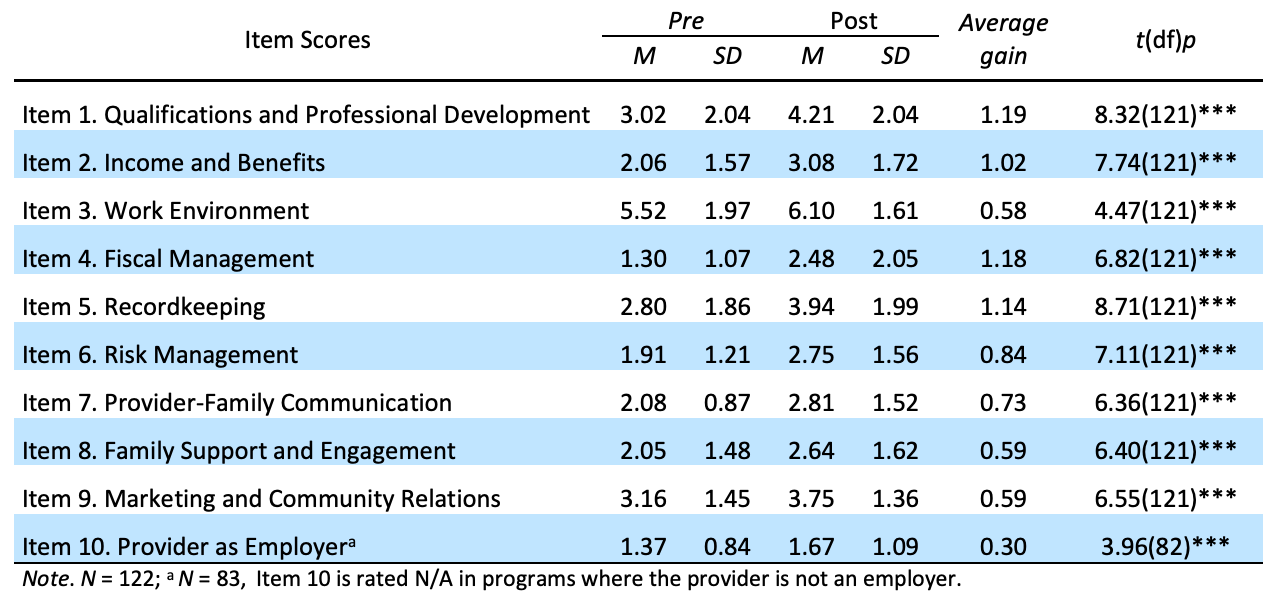
A core goal of TTL is to increase the quality of FCC business and professional practices. Changes in these practices were measured through formal BAS assessments and participant PESS responses. Pre-BAS assessments were conducted within one month of the TTL orientation session, prior to any training or assignments related to business practices. Post-TTL assessments were conducted within one month of the last TTL session. Paired t-tests of pre-post BAS showed statistically significant increases in all 10 BAS items (see Table 2). The largest gains were observed in Items 1: Qualifications and Professional Development, 4: Fiscal Management, and 5: Recordkeeping, all of which represent key factors in the sustainability of a small business. Additionally, average BAS scores increased significantly from pre- to post-TTL (M = 2.50, SD = 0.94 to M = 3.63, SD = 1.14; t = 9.35, p = .000).
Table 2
Changes in BAS Item Scores Across Time
Data from PESS surveys also underscore meaningful quality improvements associated with TTL. Participants were asked to select all of the areas of their program where they had made changes due to TTL. The most frequently reported changes related to important written documents and fiscal management tasks. Over half of the participants also noted improvements in interactions with children and in the program environment. Figure 2 provides the six most frequently reported changes and the exact percentage of participants who selected them.
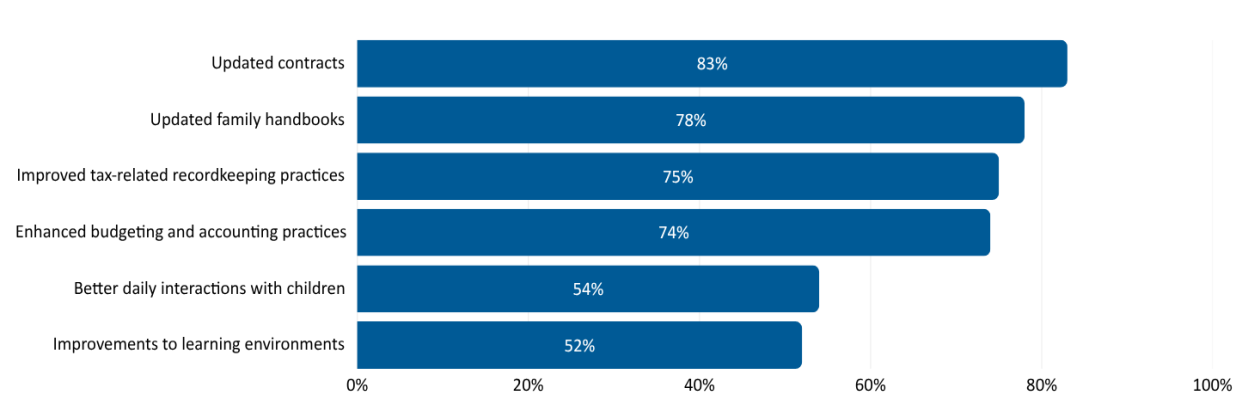
Note. N = 94.
Future Areas of Need At the conclusion of TTL, participants were also asked about their confidence in specific work areas. Despite increases in BAS scores and self-reported gains, FCC professionals still appear to have limited confidence in areas critical to business sustainability (see Figure 3). Taken together, these findings suggest that TTL produces meaningful and measurable improvements in business and professional practices, but additional professional learning is still needed. Future learning opportunities should continue to support knowledge and skill acquisition and application in these key areas.
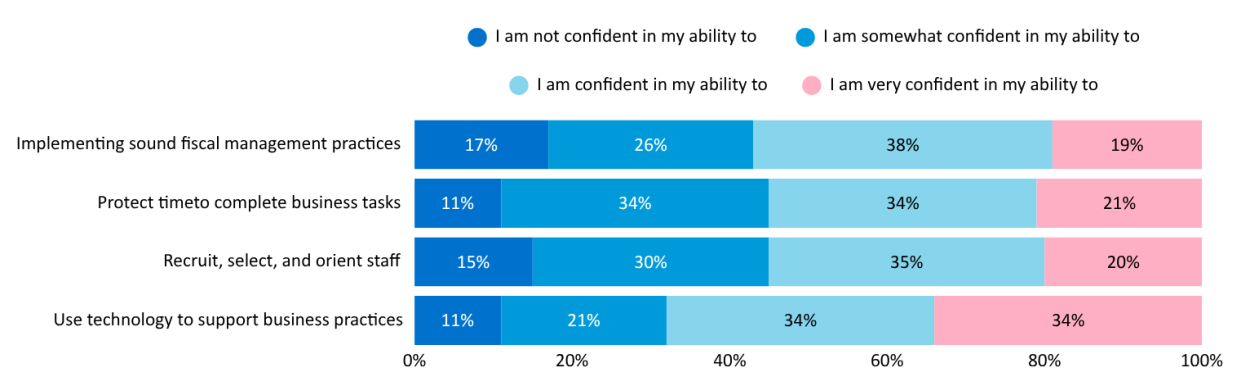
Note. N = 94.
Networking Opportunities
TTL’s monthly in-person and virtual sessions, along with peer coaching groups, support the conclusion that networking is a core feature of TTL. The authors were also interested in whether participants extended these opportunities beyond the classroom. To examine this, we analyzed data from later cohorts (N = 55) who were asked how helpful the TTL-specific GroupMe text chat was and how likely they were to stay in contact after TTL. Forty-five percent reported that GroupMe was very helpful, 42% reported that it was somewhat helpful, and 13% reported that it was not helpful. Most participants also indicated that they planned to stay in contact with their cohort after completing TTL, with 55% very likely and 42% somewhat likely to remain in contact. Only 4% reported that it was not likely they would stay in contact. Although the data are limited, these findings suggest that participants found the additional opportunities to connect outside of sessions helpful and that most intend to continue those relationships after the academy.
Leadership Self-Perceptions
Participants were also asked to share examples of how TTL had impacted them as leaders, providing a deeper understanding of the program’s effects through the voices of FCC professionals themselves. A thematic analysis of 99 open-ended responses identified four themes: leadership identity, clarity and application of business practices, advocacy and community leadership, and greater confidence in setting and communicating professional boundaries. Table 3 provides a brief description of each theme, along with the frequencies and percentages of responses.
Table 3
Thematic Analysis of Self-Reported Impact
| Theme | Description | Count | % |
|---|---|---|---|
| Leadership Identity |
Responses discussed increased self-perceptions as educational and community leaders and small business professionals. |
79 |
80% |
| Clarity and Application of Business Practices |
Responses capture a deeper understanding of, and the implementation of, critical business practices (e.g., changes to contracts and handbooks, budget development and record keeping systems, and the use of data from BAS and FCCERS-R assessments to implement QIPs). |
74 |
75% |
| Advocacy and Community Leadership |
Responses mentioned new mentoring or advocacy activities, and new or increased engagement in FCC networks/associations, and community-level organizations. |
70 |
71% |
| Communication and Boundary-Setting |
Responses referenced increased confidence around setting professional boundaries, self-advocacy, and enforcing policies with staff and clients. |
60 |
61% |
Note. N =99. Responses were coded using an inductive thematic analysis approach. Themes represent patterns across participant descriptions of professional growth. Percentages exceed 100% because responses were coded into multiple themes.
Qualitative data from participants themselves suggest that TTL not only improves business practices but also reshapes how professionals see themselves as capable leaders and small-business owners, and as professionals whose work is essential to their communities.
Demonstrations of Competencies and Commitment to Professional Growth
Participants also reported professional advancement and increased engagement in quality improvement, including earning credentials, enrolling in college coursework, and improving their program’s QRIS rating level. Table 4 provides a breakdown of the number and percentage of participants who pursued or achieved program and professional advancements.
Table 4
Demonstrations of Competencies and Commitment to Professional Growth
| Area of Change | Count | % |
|---|---|---|
| Program improvements |
||
| Program applied to increase QRIS status |
46 |
34% |
| Program applied for NAFCC accreditationa |
20 |
23% |
| Professional credentials |
||
| Participant applied to earn or increase FCC Credential |
43 |
32% |
| Participant applied to earn or increase ECE Credential |
25 |
19% |
| Participant applied to earn or increase Infant Toddler Credential |
13 |
10% |
| Participant applied to earn or increase School-Age Credential |
6 |
4% |
| Commitment to ongoing professional growth |
||
| Participant enrolled in college coursework |
24 |
18% |
| Participant joined a professional FCC network or association |
33 |
25% |
DISCUSSION
This study demonstrates the impact of an intensive professional development program designed to strengthen the business and leadership competencies of family child care (FCC) professionals. Quantitative findings revealed measurable improvements in business practices, professional engagement, and program quality, while qualitative findings highlighted powerful shifts in how TTL participants viewed themselves as leaders and business owners. Together, these findings suggest that TTL supports stronger professional practices and meaningful identity development among participants.
TTL’s findings are consistent with evidence that professional development can improve quality, support retention, and strengthen early childhood programs. However, participants’ continued uncertainty regarding fiscal management, staffing, time management, and technology indicates that additional targeted support is needed to sustain these gains. Strengthening business knowledge through ongoing professional learning may enhance financial sustainability, program stability, and engagement in QRIS, credentialing, and accreditation, with benefits that extend to children, families, and communities.
This study has several limitations, and caution should be taken when generalizing findings. First, the sample consisted of FCC professionals who voluntarily participated in TTL, so findings may represent a subset of FCC professionals who began the academy with a heightened interest and motivation for improving business practices. Second, because the study did not include a comparison group, the findings cannot establish that observed changes were caused solely by TTL. Third, while the use of formal pre- and post-BAS assessments incorporated a widely used, valid, and reliable measure of business quality, some outcomes were based on participant self-report, which may be affected by recall bias or social desirability. Fourth, not all survey items were administered to every cohort, limiting some analyses.
Despite these limitations, the mixed-methods design provides valuable evidence of both measurable change and participant-perceived impact. Future research should include longer follow-up periods, comparison groups, and additional objective measures of practice change to better understand the durability and transfer of TTL outcomes.
REFERENCES
Bromer, J., Porter, T., Jones, C., Ragonese-Barnes, M., & Orland, J. (2021). Quality in home-based child care: A review of selected literature. OPRE Report # 2021-136, Office of Planning, Research, and Evaluation, Administration for Children and Families, U.S. Department of Health and Human Services. https://www.erikson.edu/wp-content/uploads/2021/10/HBCCSQ_LitReviewExecSumm_2021-Remediated.pdf
Junus, H., Smith, L.K., & Daro, A. (2026). Who stays in the early childhood programs? Stability starts with the workforce. Buffett Early Childhood Institute at the University of Nebraska.
Kelton, R. (2020). Taking the Lead: Investing in family child care. Research Notes. McCormick Institute for Early Childhood at National Louis University. https://www.mccormickinstitute.nl.edu/taking-the-lead-investing-in-family-child-care-professionals
Kelton, R. & Tenis, I (2024a). Small business, big implications: A look at business practices in family child care programs. Research Notes. McCormick Institute for Early Childhood at National Louis University. https://www.mccormickinstitute.nl.edu/small-business-big-implications-a-look-at-business-practices-in-family-child-care-programs
Kelton, R. & Tenis, I (2024b). Family child care professionals: Understanding a critical workforce. Research Notes. McCormick Institute for Early Childhood at National Louis University. https://irp.cdn-website.com/9f82c1c2/files/uploaded/MCECL-Research-Spring-24-060724.pdf
National Center on Early Childhood Quality Assurance. (2020). Addressing the decline in family child care. Administration for Children and Families, Office of Child Care. https://childcareta.acf.hhs.gov/sites/default/files/addressing_decreasing_fcc_providers_revised _final.pdf
Talan, T., & Jorde Bloom, P. (2018). Business Administration Scale for Family Child Care (2nd ed). Teachers College Press.
Vieira, N. & Hill. S. (2017). Creating the conditions for family child care to thrive. All Our Kin.