Business Administration Scale for Family Child Care (BAS) (2nd edition)
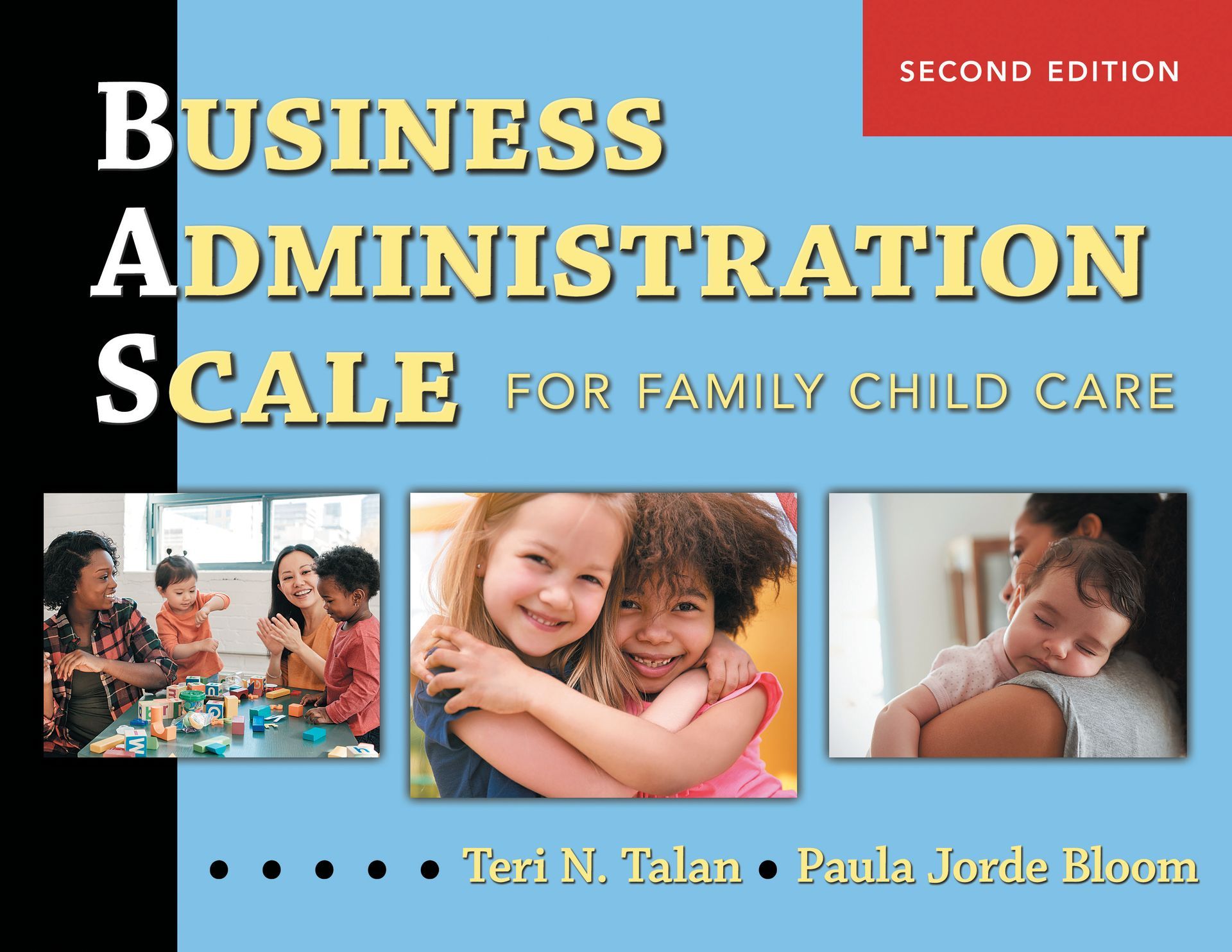
Business Administration Scale for Family Child Care (BAS) (2nd edition)
The Business Administration Scale for Family Child Care (BAS) is the first valid and reliable instrument for measuring and improving the overall quality of business and professional practices in family child care settings in 10 areas: Qualifications and Professional Development, Income and Benefits, Work Environment, Fiscal Management, Recordkeeping, Risk Management, Provider-Family Communication, Family Support and Engagement, Marketing and Community Relations, and Provider as Employer.
BAS RELIABILITY TRAINING
Is your goal to understand the Business Administration Scale for Family Child Care (BAS) at a deeper level or to use the BAS in a valid and reliable way? If so, reliability training is for you.
BAS Reliability Training provides an in-depth analysis of the items and quality indicators in the BAS. This training is designed for individuals who want to ensure that the BAS assessments are valid, reliable, and administered consistently across programs. The training concludes with a reliability test, and participants who are 85% or more reliable with the national anchors are eligible to apply for BAS Certification for an additional fee.
Click here to register for an upcoming BAS Reliability Training
Have a group you need trained? Bring our reliability training to you! Please
contact us at
pas.bas@nl.edu to learn more.
Become a Certified BAS Assessor
Certification Fee: $300
Participants who achieve an 85% reliability or higher during BAS Reliability Training are eligible to pursue certification.
Why Get Certified?
Certification is the next step in your professional learning journey—it bridges classroom instruction with real-world assessment practice. Benefits of becoming a certified assessor include:
-
Individualized Feedback
Receive personalized feedback from national anchors to help refine your skills and support ongoing professional growth.
-
Enhanced Credibility
Demonstrate to clients that your skills and expertise go beyond basic training, setting you apart as a highly qualified professional.
-
National Recognition
Be listed on the national BAS Assessor Registry maintained by the McCormick Institute for Early Childhood.
-
Access to Training Resources
Gain access to an exclusive BAS overview PowerPoint presentation, complete with a presenter outline and participant handouts.
-
Computerized Report Access
Unlock the ability to generate BAS computerized reports for future assessments (additional fee applies).
How to Get Recertified
BAS Assessor Certification is valid for five years and may be renewed through a recertification process. Recertification is also valid for a two-year period and can be renewed twice. The recertification process is described
here. If you have any questions, please contact
pas.bas@nl.edu.
RESEARCH
BAS Certified Assessor LIst
The individuals listed below successfully completed Assessor Reliability training on the Business Administration Scale for Family Child Care (BAS). During the training they achieved reliability, went on to become Certified BAS Assessors, and have maintained that certification.
National Reliability Anchors
Bella, Jill
Bella Mattina
Phone: 847.970.2342
Email: bellamattinaconsulting@gmail.com
Kelton, Robyn
McCormick Institute for Early Childhood at NLU
Phone: 847.947.5698
Email: robyn.kelton@nl.edu
Landa, Isabel
McCormick Institute for Early Childhood at NLU
Phone: 630.874.4621
Email: ilanda@nl.edu
Talan, Teri
McCormick Institute for Early Childhood at NLU
Phone: 847.947.5060
Email: teri.talan@nl.edu
Williams, Yvonne
McCormick Institute for Early Childhood at NLU
Phone: 847.947.5471
Email: ywilliams9@nl.edu
Arkansas
Eddy, Amy
Farmington, AR 72730
Phone: 479.466.1583
Email: Aeddy@astate.edu
Kirkwood, Donna
Hot Springs, AR 71901
Email: DrDonnaKirkwood@gmail.com
Knight, Jeri Lynne
Russellville, AR 7282
Phone: 479.223.7510
Email: Jknight@astate.edu
Teters, Terri
Springdale, AR 72762
Phone: 479.790.2336
Email: tteters99@yahoo.com
California
Hutchinson, Lesley
San Jose, CA 95123
Phone: (not provided)
Email: LHUTCHINSON@LIIFUND.ORG
Leon, Katie
North Hollywood, CA 91601
Phone: 818.395.2974
Email: youngdowney@att.net
Munoz, Alba
San Diego, CA 92108
Phone: 619.962.3153
Email: apchildcare@hotmail.com
Colorado
Amidon, Erin
Fort Collins, CO 80524
Phone: 401.439.6288
Email: eamidon@ecclc.org
Faux, Bobette
Florissant, CO 80816
Phone: 719.684.3679
Email: bmfaux@gmail.com
Hunt, Robin
Parker, CO 80134
Phone: 720.215.0172
Email: robin@ececc.org
Kage, Pam
Yuma, CO 80759
Phone: 970.580.9359
Email: pkage@eccywk.org
Mayes, Sarah
Castle Rock, CO 80109
Phone: 720.672.7109
Email: smayes@ecpac.org
Roeder, Lisa
Leadville, CO 80461
Phone: 719.427.0263
Email: lroeder@mtnvalley.org
Terrill, Stacy
Westcliffe, CO 81252
Phone: 801.349.5080
Watts-Patrick, Laura
Parker, CO 80134
Phone: 303.928.9098
Email: laura@acecc.org
Connecticut
Badenhop, Christopher
Bristol, CT 06010
Phone: 860.280.6235
Email: Badenhop_chris1@yahoo.com
Goldberg, Judy
Hamden, CT 06517
Phone: 203.506.4400
Email: judith.goldberg@ctunitedway.org
Goldburn, Tricia
New Haven, CT 06511
Phone: 203.487.5217
Email: triciag@ctcercle.org
Kansas
Mississippi
Montana
Ayers, Monica
Billings, MT 59105
Phone: 406.794.1883
Email: monicaayers5599@gmail.com
Hayes, Shandi
Helena, MT 59601
Phone: 406.444.9467
Email: Shandi.hayes@mt.gov
Holm, Joanna
Kalispell, MT 59904
Phone: 406.607.5648
Email: mycojc@outlook.com
New Jersey
New York
Gent, Megan
Belfast, NY 14711
Phone: 585.268.7605 ext. 1228
Email: mgent@accordcorp.org
Gonzalez, Yarimar
New York, NY 10175
Phone: 212.509.5592
Email: childcarenyc@liifund.org
Kehrley, Darlene
Ferndale, NY 12734
Phone: 845.292.7166
Email: dkehrley@scchildcare.com
Shea, Amy Keang
New York, NY 10175
Phone: 212.502.7605
Email: ashea@liifund.org
North Carolina
Pennsylvania
Briggs, Adrienne
Philadelphia, PA 19132
Phone: 215.518.9686
Email: uniqueblessingsecc@gmail.com
Campbell, Taneeshi
Philadelphia, PA 19144
Phone: 267.784.1786
Email: taneeshicampbell@gmail.com
Currier, Aimee
Perkiomenville, PA 18074
Phone: 484.869.3870
Email: aimcur@pakeys.org
Johnson, Natrice
Philadelphia, PA 19132
Phone: 215.289.5437
Email: candyskidslearningacademy@gmail.com
Long, Michelle
Tarentum, PA 15084
Phone: 724.265.1545
Email: micmal@pakeys.org
Thomas, Kendra
Philadelphia, PA 19103
Phone: 267.974.5424
Email: Kendra.Thomas@firstup.org
Ohio
Oklahoma
Hall, Juanita
Meeker, OK 74855
Phone: 405.799.6383
Email: juanitahall@ou.edu
Thompson, Jessica
Moore, OK 73160
Phone: 405.799.6383
Email: jthompson221@ou.edu
Texas
West Virginia
Briggs, Adrienne
Beckley, WV 25801
Phone: 304.362.2982
Email: brianna.d.wesley@wv.gov
Conley, Brooklyn
Matheny, WV 24860
Phone: 304.682.8271
Email: brooklyn.a.conley@wv.gov
Dennison, Melisa
Huntington, WV 25701
Phone: 304.523.9540
Email: Melisa.A.Dennison@wv.gov
Gaston, Lacy
Wellsburg, WV 26070
Phone: 304.670.1486
Email: Lacy.j.gaston@wv.gov
Gillis, Chris
Wheeling, WV 26003
Phone: 304.232.1603
Email: Chris.L.Gillis@wv.gov
Hayes-Beall
Hedgesville, WV 25427
Phone: 304.279.4745
Email: Patty.L.HayesBeall@wv.gov
Hutson, Melissa
Grafton, WV 26354
Phone: 304.265.0035
Email: melissa.s.hutson@wv.gov
Jobes, Ashley
Parkersburg, WV 26104
Phone: 304.485.2668
Email: ashley.n.jobes@wv.gov
McClure, Samantha
Ronceverte, WV 24970
Phone: (not provided)
Email: Samantha.J.McClure@wv.gov
Mueller, Marcy
Bridgeport, WV 26330
Phone: 304.629.0062
Email: Marcy.l.Mueller@wv.gov
Powell, Jennifer
Parkersburg, WV 26104
Phone: 304.485.2668
Email: Jennifer.S.Powell@wv.gov
Shaffer, Emma
Charleston, WV 25303
Phone: 304.348.3672
Email: emma.l.shaffer@wv.gov
Smith, Ashley
Charleston, WV 25311
Phone: 304.348.3668
Email: ashley.b.smith@wv.gov
Swindler, Amber
Huntington, WV 25701
Phone: 215.518.9686
Email: Amber.L.Swindler@wv.gov