
McCormick Institute for Early Childhood

BY McCormick Center | February 16, 2016

This document may be printed, photocopied, and disseminated freely with attribution. All content is the property of the McCormick Center for Early Childhood Leadership.

This resource is part of our Research Notes series. 


Research suggests that emotional support improves children’s academic and social development. Children in classrooms characterized by emotionally supportive teachers and environments are less likely to exhibit problem behaviors, negative affect, and aggression.

Research also suggests the organizational climate of early childhood programs affects overall program quality. A recent study by Katherine Zinsser and Timothy Curby examined early childhood centers to determine if various center characteristics could predict teachers’ emotional support of children in their classrooms.1


SAMPLE AND DATA ANALYSIS


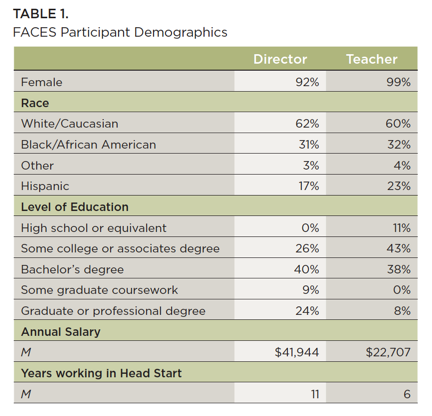
The researchers used the Head Start Family and Child Experiences Survey (FACES) 2009 dataset to analyze 370 classrooms from 120 centers.2 The directors were interviewed about program characteristics, management practices, and their personal experiences and satisfaction in the workplace. They also reported about their job satisfaction by answering a questionnaire. Table 1 summarizes characteristics of directors and teachers in the FACES study.

A table showing the demographics of a teacher and director

The Classroom Assessment Scoring System (CLASS) was used to examine four dimensions of emotional support among teachers and children: Positive climate, negative climate, teacher sensitivity, and regard for student perspectives.3


Hierarchical Linear Modeling (HLM) was the method used to analyze the relationship among factors at the classroom and centerwide levels that were related to the four Emotional Support Dimensions CLASS scores. One factor at the classroom level (teacher-child ratio) and 7 factors at the center-wide level (directors’ level of education, directors’ salary, teacher turnover rate in the past year, steps to address turnover, directors’ job satisfaction, management challenges, and supportive management practices) were incorporated in the model.


RESULTS


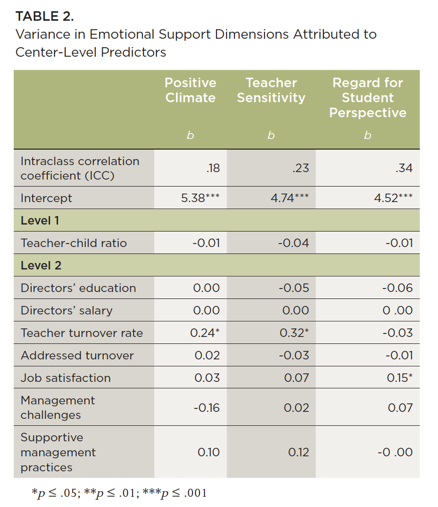
The analysis of the overall model showed there were significant differences for three of the four Dimensions of Emotional Support by calculating an intra-class correlation coefficient (ICC): positive climate (ICC = .18), teacher sensitivity (ICC = .23), and regard for student perspectives (ICC = .34). Significant ICC values explain the amount of variance in emotional support that can be attributed to center characteristics. Thus the amount of variance in CLASS scores attributed to center-level characteristics was 18% for positive climate, 23% for teacher sensitivity, and 34% for regard for student perspectives. Significant differences were not found for the dimension of negative climate suggesting this dimension could be affected more by classroom characteristics than from those of the overall center


Surprisingly, teacher turnover positively predicted emotional support in the dimensions of positive climate (b = 0.24, p < .05) and teacher sensitivity (b = 0.32, p < .05). Directors’ job satisfaction was found to significantly predict regard for student perspectives (b = 0.15, p < .05). Table 2 shows the variance found in the emotional support dimensions as predicted by center-level characteristics.

A table showing the variance in emotional support dimensions attributed to center-level predictors

IMPLICATIONS FOR POLICY, PRACTICE, AND RESEARCH


There is substantial evidence that teacher-child interactions impact children’s development and learning.4 We also know organizational climate influences teaching practice.This study highlights these relationships and teases out some important dimensional relationships. While these findings do not demonstrate a causal link from teacher turnover and directors’ job satisfaction to child outcomes, they do provide evidence of the impact of workplace climate on both teacher dispositions and classroom environments.


While the disruption caused by teacher turnover is typically regarded as a negative indicator of program quality, these findings suggest there may be some positive effects when teachers leave. The authors suppose this could result from underperforming teachers who are counseled out or terminated from their programs, newly hired teachers could be better educated, or incoming teachers may be trained to better support the social and emotional development of children.


The relationship between directors’ job satisfaction and positive regard for students’ perspectives is also an important finding from this study. It is important to note that this finding does not confirm the direction of the relationship—whether directors who are satisfied on the job influence teachers to adopt a child-focused approach or whether teachers’ regard for student autonomy contributes to the workplace environment, thus affecting directors’ job satisfaction.


Regard for student perspectives is an essential dimension of emotional support concerned with teacher-child interactions that focus on children’s interests, motivations, and points of view.6 The CLASS assesses the degree to which teachers are flexible in their plans; accept children’s ideas and organize learning activities around their interests; support children’s autonomy and leadership; and provide children with opportunity for expression and freedom to move around. It is reasonable to expect that a director with strong self-efficacy beliefs and contentment about the workplace would allow for this kind of classroom climate. This research indicates there is a relationship between directors’ satisfaction at work and the emotional support teachers provide to children.


Zinsser and Curby suggest that factors like enjoying work, belief that one is making a difference, and commitment to early childhood education are the kind of dimensions that contribute to director’s job satisfaction. Directors who are reflective practitioners and think positively about their personal leadership and the effectiveness of their program are likely to have a high regard for their work and workplace. Overly-controlling directors and administrators contribute to an organizational climate that translates to rigid and narrowly defined teaching practices.


  1. Zinsser, K. M., & Curby, T. W. (2014). Understanding preschool teachers’ emotional support as a function of center climate. SAGE Open. doi: 10.1177/2158244014560728.
  2. U.S. Department of Health and Human Services, Administration for Children and Families, Office of Planning, Research and Evaluation. (2013). Head Start Family and Child Experiences Survey (FACES): 2009 Cohort. Washington, DC.: Author.
  3. Mashburn, A. J., Pianta, R. C., Hamre, B. K., Downer, J. T., Barbarin, O. A., Bryant, D., & … Howes, C. (2008). Measures of classroom quality in prekindergarten and children’s development of academic, language, and social skills. Child Development, 79(3), 732–749.
  4. Hamre, B. K., & Pianta, R. C. (2007). Learning opportunities in preschool and early elementary classrooms. In R. C. Pianta, M. J. Cox, and K. L. Snow (Eds.), School readiness and the transition to kindergarten in the era of accountability (pp. 49–83). Baltimore, MD: Paul H. Brookes.
  5. Bloom, P. J., & Abel, M. A. (2015). Expanding the lens: Leadership as an organizational asset. Young Children 70(2), 8–13.
  6. Pianta, R. C., La Paro, K. M., & Hamre, B. K. (2008). Classroom assessment scoring system manual, Pre-K (pp. 38–42). Baltimore, MD: Paul H. Brookes.
By Dr. Neal Green February 8, 2026
Tools: Gemini Gems, NotebookLM, Perplexity Spaces Overview The evidence is clear that early childhood professionals' most significant challenge is a lack of time. Artificial Intelligence (AI) tools, when used strategically, can give administrators some of the time they desperately need, allowing them to focus more on their staff and the children and families in their care. This approach aligns with the foundational goal of strengthening leadership effectiveness and program impact (Abel, Talan, & Masterson, 2023). When I scan the AI landscape of available products and platforms, it becomes overwhelming. There are so many options that it is impossible to keep up with every new development. Focusing on a limited number of AI tools backed by organizations with strong infrastructure and fiscal stability is a wise place to start your AI journey. McCormick Institute for Early Childhood’s (MIEC’s) upcoming professional development sessions will focus on three AI tools. These include Gemini Gems, NotebookLM, and Perplexity Spaces. Think of Gemini Gems as your customized AI assistant that you "train" to follow your rules and meet your goals. Gemini Gems are the right tool to tackle Internal Operations . NotebookLM is perfect for creating Family Support resources that stick. NotebookLM is a powerful AI tool that uses only the documents or other resources you add to generate specific, focused output. Perplexity Spaces is a fantastic choice to address Marketing demands. Like many AI tools, you can toggle back and forth between open web searches and focused documents that are specific to your work. Gemini Gems: The “Specialist Teammate” Gemini Gems allow you to create templates you can use repeatedly for agendas, HR policies, and more. If you have used AI in the past, you know that writing an effective prompt takes time, and they can easily get "lost" if you use AI often. Gems removes that challenge and lets you save your most effective prompts without having to rewrite them every time you use Gemini. It is up to you to decide if you want to create several smaller Gems to tackle common challenges you face or create larger Gems that encompass large swaths of your work. For our purposes, we will focus our Gem work on Internal Operations, addressing Program Administration Scale (PAS) Item 9: Internal Communications (Talan & Bloom, 2011). Imagine using a Gem to turn messy staff meeting notes into professional minutes with clear action plans in minutes or less! NotebookLM: The "Walled Garden" NotebookLM is an excellent tool for Family Support for your center, addressing PAS Item 17: Family Support and Involvement (Talan & Bloom, 2011). After uploading documents and resources, such as your parent handbook or community referral lists, to your Notebook, you can create several resources that parents/guardians of your center students will love. Just a few of the impressive features available with NotebookLM include audio (podcast) summaries, video summaries, and reporting functions with templates or the option to create your own report with metrics that matter most to you. Perplexity Spaces: The "Research Librarian" Perplexity Spaces is a perfect AI partner for Marketing your early childhood education (ECE) program, addressing PAS Item 18: External Communications (Talan & Bloom, 2011). You can build your own centralized repository, with control over branding to ensure consistency and present a professional, current image. Adding specific instructions to your space eliminates the need to format documents constantly and saves valuable time. The consistency that a Perplexity Space offers in this regard allows you to upload messages that are the "voice” of your brand. Your marketing efforts are not only more aesthetically pleasing but also enable you to track trends at similar centers in your area, helping you assess the competition. Strategies for Success: Audit your Internal Communications: Identify one repetitive task, such as creating staff meeting agendas (PAS Item 9), and automate it with a Gemini Gem. Curate your Family Resources: Gather three to five existing documents to "feed" a NotebookLM project for more responsive family support (PAS Item 17). Standardize your Brand: Use a Perplexity Space to ensure all public relations tools project a consistent, professional image (PAS Item 18). Reflection Questions: Which administrative task takes the most time away from your interactions with staff and families? How might centralizing marketing materials (branding) impact the professional image to prospective families? Table 1: AI Tools for ECE Professionals
Show More