Stronger Together
BY Teri N. Talan, J.D., Ed.D. | September 21, 2020
This document may be printed, photocopied, and disseminated freely with attribution. All content is the property of the McCormick Center for Early Childhood Leadership.
Research is clear—leadership matters when it comes to high-performing early childhood education programs (Early Childhood Leadership Development Consortium, 2016; Doherty, Ferguson, Ressler, and Lomotey, 2015; Dennis and O’Connor, 2013). Sustainable program quality is hindered, however, by a lack of consistent standards, policies, and supports for the professional qualifications and competencies of those who lead early childhood programs. The leadership gap is most evident between center administrators and elementary school principals serving Pre-K children (Abel, Talan, Pollitt, and Bornfreund, 2016; Lieberman, 2017). While a master’s degree in educational leadership is the norm for elementary school principals, only a handful of states require a minimum of an associate degree for directors of child care centers. No state requires a degree for administrators of licensed/registered family child care programs (Abel, Talan, and Magid, 2018).
The Transforming the Workforce for Children Birth through Age 8: A Unifying Foundation Report (Institute of Medicine and National Research Council, 2015) made a recommendation to strengthen the capacity of early childhood program leaders. The report set forth the need for common language, clearly defined priorities, and cohesive direction to support the initial preparation and ongoing professional development of site-based program leaders. In response to this seminal report, the McCormick Center for Early Childhood Leadership developed the Whole Leadership Framework (Masterson, Abel, Talan, and Bella, 2019). This framework is unique in conceptualizing three interdependent domains of early childhood education (ECE) program leadership: administrative leadership, pedagogical leadership, and leadership essentials.
In spite of what is known about the impact of effective leadership on program quality, leadership development systems are fragmented and there is a lack of sustained, systematic oversight to guide the ECE program leadership profession (New Venture Fund, 2018). Goffin (2013) notes that a clear consensus about the role, definition, and development of leaders is lacking, and advancing cohesiveness in early childhood leadership capacity as a profession is critical.
The McCormick Center for Early Childhood Leadership, with the support of the Foundation for Child Development, recently conducted a study to determine whether there was consensus among ECE leadership stakeholders about the need for a unified professional framework for onsite administrators of early learning programs. Whether leaders are in schools, centers, or licensed family child care homes, is there consensus on the core competencies needed to sustain learning environments in which children, families, and staff thrive?
METHODOLOGY
For this study, there were four waves of data collection, comprising a total of fourteen virtual sessions. Each virtual session was 90 minutes in duration. Participants in each of the first three waves (total of nine virtual sessions) considered a series of questions related to one or more key areas of a unified professional framework for ECE program and site leaders. Participants in each wave were asked the same questions and the highest ranked responses were then added to the choices ranked in subsequent sessions in the same wave. Participants in the fourth wave (total of five virtual sessions) responded to a draft report synthesizing the findings and five recommendations generated from the first three waves.
This iterative process was facilitated by the Advance Strategy Center, utilizing an online platform (Advance Strategy Lab) in which participants provided simultaneous and anonymous responses to both structured and open-ended questions. The anonymous responses were immediately visible to all participants in the session. Participants were asked to rate the responses using a 1-5 agreement scale or 1-10 significance scale. The highest ranked responses were then included in the responses of subsequent sessions in the same wave. This unique methodology, while similar to focus group research, creates an inclusive shared space in which all voices are equally powerful.
SAMPLE
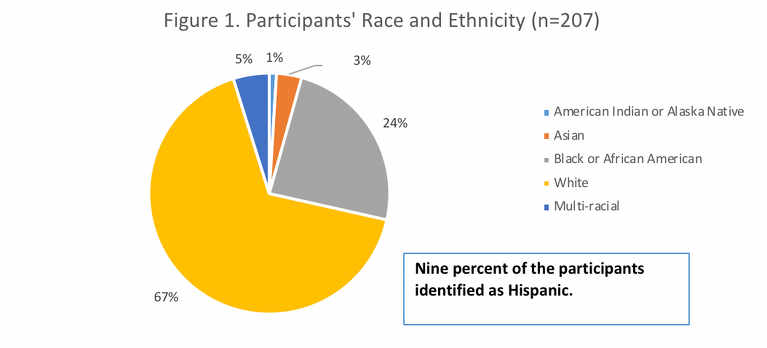
A total of 207 ECE leadership stakeholders, from 32 states and the District of Columbia, registered to participate in one or more of the four waves of data collection. The national sample provided representation from three ECE stakeholder groups: program and site leaders (22%); higher education faculty and leadership developers (38%); and national and state system leaders (40%). Figure 1 provides detail on the racial and ethnic diversity of those who registered for one or more of the virtual sessions.
RESEARCH QUESTIONS
Wave 1
- Is there a need for a unified professional identity for onsite leaders of early learning programs?
- What are the obstacles to creating a unified framework for program and site leaders across settings and sectors?
- What are the advantages to a unified framework for program and site leaders across settings and sectors?
Wave 2
- What are the core competencies shared by program and site leaders working in schools, centers, and homes?
- Can the three domains of the Whole Leadership Framework be utilized to organize the core competencies of program and site leaders? If so, what is missing? What does not belong?
- For what child or program outcomes are onsite leaders (e.g., principals, directors, FCC providers) accountable?
Wave 3
- What are the minimum educational requirements for program or site leaders?
- Should there be multiple levels of education and specialized knowledge and skills? If so, should they build on the foundation of the Early Educator I, II, and III (established in Power to the Profession)?
- What criteria should determine compensation parity for program and site leaders across sectors and settings?
Wave 4
- Assuming an equitable and sufficient distribution of resources to support the vision, do you agree with the five consensus recommendations for a unified professional identity for future program and site leaders working across sectors and settings?
The data were analyzed in each wave to determine where there was consensus about the components of a unified professional framework for onsite program leaders.
RESULTS
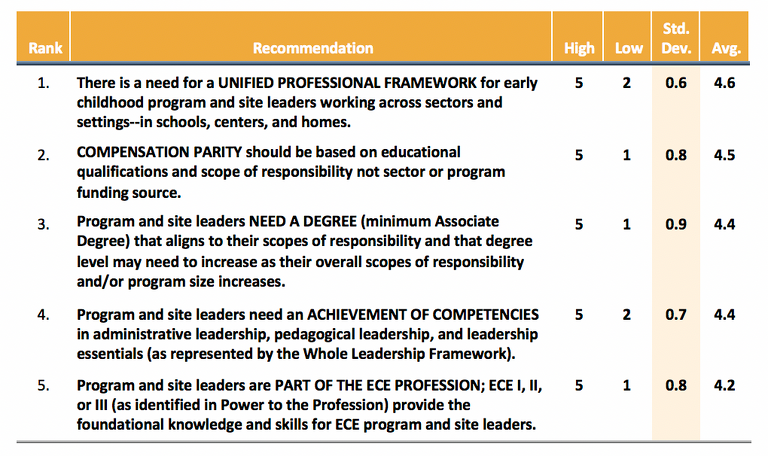
During the first three waves, consensus was reached on five recommendations. During the fourth wave, additional feedback was obtained on the five consensus recommendations and on the draft report. The fourth wave included 75 additional leadership stakeholders to expand the feedback. For each recommendation, participants were asked whether they agreed with the recommendation (5-point agreement scale) and then to explain their response and level of agreement. The agreement assessment is shown below, listed from highest to lowest agreement:
KEY FINDINGS
All five of the recommendations had a strong level of agreement (4.2 through 4.6 on a 5-point agreement scale). While there were nuances (such as the degree type or the level of the ECE credential required as a foundation) it is clear that there is a fundamental need for a unified framework for program leaders and agreement on equitable compensation based on educational qualifications and responsibilities; a minimum requirement of a degree; achievement of competencies aligned to the Whole Leadership Framework; and a foundation of the ECE Level I, II, or III (established in Power to the Profession). These five consensus recommendations developed in the earlier waves and “tested” in Wave 4 with additional participants, appear to be strong pillars for the development of program leadership for the future.
The recommendation for a unified professional framework received the strongest level of agreement (4.6 on a 5 – point agreement scale). The strength of conviction about this recommendation can best be understood through the open-ended comments, some of which are shown below:
STRONGLY AGREE: “There are wide disparities in the field depending upon where someone works and/or where the program is located. Children deserve the highest quality regardless of what program they attend–leadership should reflect this.”
STRONGLY AGREE: “A unified framework is an essential foundation for shaping choices professionals make to move into leadership positions, pre-service and in-service training, and to shape the ecosystem we need to support leaders.”
STRONGLY AGREE: “A common framework is an essential element of a profession. Having a common framework that is recognized by the field will allow members of the field a clearer understanding of the field and will allow for more effective advocacy with policymakers.”
STRONGLY AGREE: “With the expansion of early childhood education into the school system and the continued research that reveals the immense value of early childhood education, we must get to a place where the leaders in this field have a unified focus for quality.”
STRONGLY AGREE: “In our global marketplace, a standard across all states is needed to ensure all children and families will receive the highest quality programming. Working together across sectors focuses back to doing what is best for the children and not competing between sectors.”
DISCUSSION
Unified Framework
Early childhood program leadership stakeholders—comprised of program and site leaders, higher education faculty and leadership developers, and national and state system leaders—agreed about the need for and value of a unified professional framework for early childhood program and site leaders working in schools, centers, and homes. The rationale most frequently provided was that a united voice has the greatest impact on policy and funding decisions.
Core Competencies
The three stakeholder groups were also closely aligned regarding the core competencies of program and site leaders across sectors and settings. The vast majority of participants (81%) in the study believed that program and site leaders needed a balance of administrative and pedagogical competencies to lead high-performing early childhood care and education organizations. The Whole Leadership Framework, with its three interdependent domains of administrative leadership, pedagogical leadership, and leadership essentials, substantially reflects the leadership competencies most valued by the project participants. It is notable that the five most highly-ranked core competencies for program and site leaders working across sectors and settings included competencies from all three of the Whole Leadership domains.
Minimum Educational Level
There was a clear consensus that program and site leaders need a degree. However, there was not consensus on what level degree that should be. Most of the participants believed that a minimum should be set at the baccalaureate level. Other participants suggested that the level of degree be based on the scope of responsibilities of the program or site leader. In this scenario, an associate degree would be the minimum educational requirement for the leader of a home-based program, a baccalaureate degree would be the minimum for the leader of a center-based program, and a graduate degree would be the minimum for the leader of a school-based program.
There was also diversity of opinion on whether the degree needed to be in early childhood education. A significant number of comments suggested that a degree in program administration or business or elementary education would be fine if supplemented with early childhood education courses. There were numerous comments emphasizing the value of multiple pathways to preparing qualified program and site leaders.
ECE I, II, or III as a Foundation for Onsite Program Leaders
In the future, the professional preparation for program and site leaders should be linked to ECE I, II, or III of the Power to the Profession (P2P) framework. More than four-fifths of participants indicated that ECE I, II, or III should be the foundation on which additional leadership competencies sit. However, there was no agreement on which level is most appropriate. There needs to be more discussion on this topic as the P2P recommendations become implemented in policy. The largely consistent responses building program leadership competency on the foundation of the ECE levels of preparation indicate that early childhood leadership stakeholders view program and site leaders as part of the ECE profession.
Compensation Parity
Compensation parity was the second most frequently stated rationale for the need of a unified professional framework for early childhood program and site leaders. Clear consensus was reached that compensation should be based on mastery of core leadership competencies and the achievement of a requisite educational degree. Scope of responsibility was identified as another important criteria determining compensation parity. Most of the comments suggested that scope of responsibility was determined by the number of children and families served or the number of staff supervised by the leader.
Achieving consensus on the north star of a unified framework for the professional preparation and compensation of program and site leaders is, however, only the first step on the journey. Creating the broad buy-in, system change, and funding so that early childhood education and care leaders have equitable access to the education and training, as well as additional supports, to achieve these professional standards will be the challenges ahead in the next few years.
LIMITATIONS AND NEED FOR FURTHER RESEARCH
While participants in this study were racially, culturally, and geographically diverse, some participants suggested in their feedback the need for further research using focus groups to make sure that the consensus recommendations represent the views of Black and Latino/a program leaders. Applying a racial equity lens, additional data collection using focus groups should be utilized to ensure that the voices of people of color are fully represented in the consensus recommendations.
Nomenclature is closely associated with professional identity. Even though this issue was discussed in each of the four waves, consensus on a unified role title was not reached. This is an area that needs further research and consideration. Is the variation in responses due to the unique professional identities of program and site leaders working in different sectors and settings? Or, is the variation in responses due to the professional identities of the leadership stakeholders engaged in the Building Leaders Project? A qualitative analysis of the comments submitted during the four waves of data collection may provide a clarification of the nomenclature issue and an answer to the question, “what’s in a name?” Finally, the four waves of data collection produced rich qualitative data that deserve a full analysis. Specifically, a qualitative analysis of the feedback generated by each of the three stakeholder groups could illuminate areas where consensus was not reached and shed light on how to move the profession forward in these areas.
REFERENCES
Abel, M. B., Talan, T. N., & Magrid, M. (2018). Closing the leadership gap: 2018 status report on early childhood program leadership in the United States. Wheeling, IL: McCormick Center for Early Childhood Leadership. Retrieved from https://mccormickcenter.nl.edu/wp-content/uploads/2019/02/2018-LEAD-Clearinghouse-webbook_04.pdf
Abel, M. B., Talan, T. N., Pollitt, K. D., & Bornfreund, L. (2016). National principals’ survey on early childhood instructional leadership: Executive summary. McCormick Center for Early Childhood Leadership Publications. Paper 1. http://digitalcommons.nl.edu/mccormickcenter-pubs/1
Dennis, S., & O’Connor, E. (2013). Reexamining quality in early childhood education: Exploring the relationship between the organizational climate and the classroom. Journal of Research in Childhood Education 27(1), 74–92.
Doherty, G., Ferguson, T., Ressler, G., & Lomotey, J. (2015). Enhancing child quality by director training and collegial mentoring. Early Childhood Research and Practice 17(1). Retrieved from http://ecrp.uiuc.edu/v17n1/doherty.html
Early Childhood Leadership Development Consortium, (2016). Early childhood leadership consensus statement, Washington, DC. Retrieved from https://www.fcd.us.org/assets/2017/03/ECELeadershipStatement2016.pdf
Goffin, S. (2013). Building capacity through an early education leadership academy. Center on Enhancing Early Learning Outcomes (CEELO). Retrieved from http://ceelo.org/wp-content/uploads/2013/12/EELA_Goffin_WEB.pdf
Institute of Medicine, and National Research Council. 2015. Transforming the Workforce for Children Birth through Age 8: A Unifying Foundation. Washington, DC: The National Academies Press. Retrieved from https://www.fcd-us.org/assets/2016/10/IOMNRCFullReport2015.pdf
Lieberman, A. (2017). A tale of two pre-K leaders: How state policies for center directors and principals leading pre-K programs differ and why they shouldn’t. Washington, DC: New America.
Masterson, M., Abel, M., Talan, T., and Bella, J. (2019). Building on whole leadership: Energizing and strengthening your early childhood program. Lewisville, NC: Gryphon House, Inc.
New Venture Fund. (2018).
Developing Early Childhood Leaders to Support Strong, Equitable Systems: A Review of the Early Childhood Education Leadership Development Landscape. Retrieved from https://www.arabellaadvisors.com/wp-content/uploads/2018/07/New-Venture-Fund_Packard_report.pdf
Dr. Teri Talan, J.D., Ed.D, holds the Michael W. Louis Chair and is senior policy advisor at the McCormick Center for Early Childhood Leadership and professor of early childhood education at National Louis University (NLU). She promotes action by state and national policymakers on early childhood workforce and program administration issues. Previously, she led a child advocacy organization and an early childhood program accredited by the National Association for the Education of Young Children (NAEYC). She holds a law degree from Northwestern University as well as a master’s degree in early childhood leadership and advocacy and a doctorate in adult and continuing education from NLU. She is coauthor of the of the
Program Administration Scale;
Business Administration Scale for Family Child Care;
Escala de Evaluación de la Administración de Negocios;
Who’s Caring for the Kids? The Status of the Early Childhood Workforce in Illinois; and
Closing the Leadership Gap.