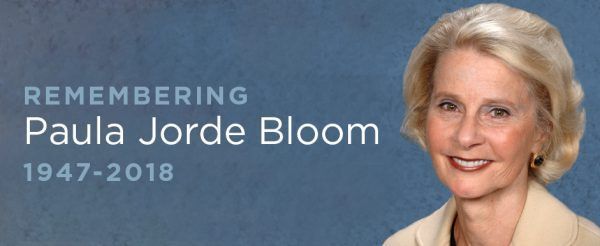
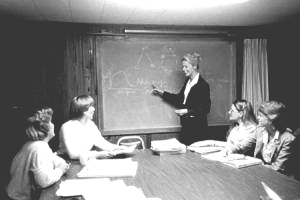
It is with great sadness that we share with you the news of the passing of Dr. Paula Jorde Bloom—our founder, an extraordinary visionary, and a “gatekeeper to quality.”
For nearly two decades, Paula lived with a cancer that was expected to take her life years ago, outlasting numerous doctors’ predictions. Paula died at her home on Saturday, February 17, 2018, in Lake Bluff, Illinois.
Paula’s journey in early childhood leadership began in 1975, when, with the support of local philanthropists, she designed and brought to life the child care center of her dreams in Alamo, California. Classrooms were spacious. Windows were abundant. Farm animals and a vegetable garden were thriving in an expansive yard. Children were happy and engaged with a developmentally appropriate curriculum. Yet, something was missing. Operating a sustainable program required more skills and knowledge than Paula felt she possessed.
“While I had been a very talented and accomplished classroom teacher, I had no clue about program administration and had had no formal organizational leadership and management courses,” Paula reflected. “At that time, I didn’t know the difference between a debit and a credit.” This experience fueled Paula’s passion and life’s work.
Paula dedicated the rest of her life to not only bringing national attention to the role of leaders in early care and education, but also to inspiring those leaders to learn more and improve the quality of their programs. She went on to be an instructor at Mills College and the director of the campus lab school. Paula completed her doctorate at Stanford University, moved to the Chicago area, and started as an assistant professor at National Louis University (then National College of Education). In 1985, she applied for and received a $600 Membership Action Grant from the National Association for the Education of Young Children (NAEYC) to start the Early Childhood Professional Development Project. Ultimately, the project, which focused on directors of early care and education programs, led to the founding of another center. This one, though, would focus on leadership development for those in early childhood. Her goals for the McCormick Center for Early Childhood Leadership were to identify, define, and support the competencies of early childhood program administrators and to bring credibility to the importance and complexity of the administrator’s role. While nationally renowned, and the executive director of a premier organization, Paula was surprisingly humble. She was also gracious in her unwavering drive to support early childhood program leaders. She did not take “no” for an answer. Paula was able to grow the McCormick Center and improve standards for administrators as a result.
Throughout the next 30 years, Paula devoted her work to supporting program administrators, whom she referred to as the “gatekeepers to quality.” She authored scores of journal articles and resources including the widely read Director’s Toolbox management book series and the Early Childhood Work Environment Survey (ECWES), an organizational climate assessment tool. She also co-authored the first valid and reliable tools to measure early childhood leadership and management, the Program Administration Scale (PAS) and the Business Administration Scale for Family Child Care (BAS). Academically, she chaired the department of early childhood education, became the Michael W. Louis endowed chair, and more recently became professor emerita. In her spare time, when not immersed in activities with her beloved husband Darrell and their family, Paula was president of New Horizons, a publishing company specializing in resources to support program administration.
Over the years, Paula served on countless boards and committees informing their work in the development of early childhood director competencies, credentials, and coursework. Her pioneering efforts have been the basis for the national and state emphasis that exists on leadership today. Early observations led Paula to recognize that there were not many professional development opportunities for early childhood leaders, so she began Taking Charge of Change, a groundbreaking year-long institute where directors could learn best practices, be mentored, and network. The institute now serves as a model for states striving to improve program quality. Her maxim “quality is a moving target” guided a myriad of directors to embrace systems thinking and create work environments where the norm was continuous quality improvement.
This norm of perpetual growth was not just for the directors whom she served. It also became a guiding principle for the McCormick Center. Paula inspired us to move mountains and taught us that we are catalysts for change. She was the embodiment of what she preached. We will miss the positive energy she instantaneously generated upon entering a room.
Paula’s far-reaching impact on the field of early childhood is widely recognized and much celebrated, most recently being named a doyen by Exchange. For her retirement celebration in 2014, scores of colleagues across the country called the McCormick Center to leave Paula voicemails of endearment, congratulations, and a tremendous amount of gratitude. You can listen to some of them here, as well as read Paula’s inspiring retirement address. Unsurprisingly, Paula did not stop working when she “retired.” Instead, she worked on new editions of several of her most widely read books and trainer’s guides. And, despite knowing her time among us was nearing an end, Paula continued to work on projects and offer insights that will undoubtedly move the field forward.
“We are somber today and at the same time celebrating everything Paula contributed and the legacy she began with just a few hundred dollars and a single idea,” said Teri Talan, Michael W. Louis Chair of the McCormick Center. “We are dedicated to building on Paula’s tremendous vision and contributions. Our drive to improve the quality of early childhood education nationwide persists. We remain dedicated to supporting administrators in their passion to provide high-quality programs for the families and children who depend on their leadership.”
Thank you, Paula. Thousands of children, families, and early childhood leaders have a brighter future because of you.
A memorial service to celebrate Paula’s life will be held on March 2nd at 1:00 p.m. in the John and Nancy Hughes Theater at the Gorton Center, 400 East Illinois Road, Lake Forest, IL 60044. A reception will follow in the Stuart Room. Paula’s family has asked us to share that in lieu of flowers, contributions can be made to the Paula Jorde Bloom Scholarship Fund for Leadership Education at the McCormick Center for Early Childhood Leadership at National Louis University, 6200 Capitol Drive, Wheeling, IL 60090.