McCormick Institute for Early Childhood

BY McCormick Center | November 30, 2016

A woman wearing glasses and a suit is smiling in front of a flag.

Sim Loh is a family partnership coordinator at Children’s Village, a nationally-accredited Keystone 4 STARS early learning and school-age enrichment program in Philadelphia, Pennsylvania, serving about 350 children. She supports children and families, including non-English speaking families of immigrant status, by ensuring equitable access to education, health, employment, and legal information and resources on a day-to-day basis. She is a member of the Children First Racial Equity Early Childhood Education Provider Council, a community member representative of Philadelphia School District Multilingual Advisory Council, and a board member of Historic Philadelphia.


Sim explains, “I ensure families know their rights and educate them on ways to speak up for themselves and request for interpretation/translation services. I share families’ stories and experiences with legislators and decision-makers so that their needs are understood. Attending Leadership Connections will help me strengthen and grow my skills in all domains by interacting with and hearing from experienced leaders in different positions. With newly acquired skills, I seek to learn about the systems level while paying close attention to the accessibility and barriers of different systems and resources and their impacts on young children and their families.”

This document may be printed, photocopied, and disseminated freely with attribution. All content is the property of the McCormick Center for Early Childhood Leadership.

This resource is part of our Research Notes series.


An important function of administrators seeking to improve program quality is to ensure that staff have access to a range of professional development (PD) opportunities. The director’s role in supporting access to PD involves much more than sharing information about training opportunities.1 It includes providing access to resources, setting aside planning time, providing career guidance, and establishing a career ladders within the program.


While there is wide consensus about the importance of professional development, there is a lack of research on the specific ways early childhood programs implement it. To address this issue, the McCormick Center for Early Childhood Leadership recently conducted an online survey to explore the type and usefulness of various professional development opportunities in center-based early childhood programs.


SAMPLE AND MEASURES


Participants were solicited from approximately 29,000 constituents of the McCormick Center’s database. Information about the participants and their programs was collected. Of the 576 respondents, 71% served in an administrative capacity (director, assistant director, or component coordinator) and 29% were teachers. Three-fourths of the sample held a bachelor’s degree or higher. On average they had worked in the field for 20 years, with an average of 11 years at their current employer. They represented programs in 44 states, the District of Columbia, and American Samoa.


The online survey was designed to assess the frequency of 11 professional development supports found in center-based programs. It also assessed whether PD supports strengthened respondent’s level of professional competence, their perceptions about the importance of professional development activities, and their level of commitment to their current job.


FINDINGS


Findings indicated that most center-based programs offered some professional development supports, but did not provide a comprehensive PD program. Of the 11 types of PD supports, the average number offered in centers was 6.15 (SD = 2.69).


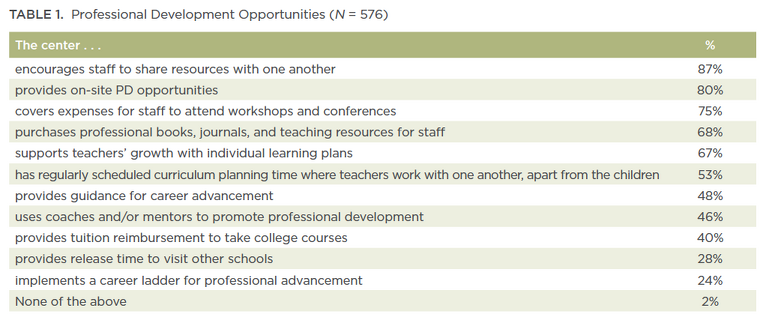
A majority of programs provided digital and print resources, on-site professional development, and scheduled curriculum planning time. They also paid for off-site professional development and utilized individual learning plans. However, more than half of respondents’ programs did not support their staff with career guidance, coaches/mentors, or offer tuition reimbursement for college coursework. Only one-fourth of programs offered release time to visit other schools or had a career ladder in place. Table 1 shows the percentage of professional development supports offered by programs in rank order.

A table with a lot of numbers on it

Less than one-half of respondents (43%) felt that the professional development opportunities provided in their programs were very helpful in strengthening their level of professional competence. However, a high percentage of respondents (82%) felt that taking part in professional development activities was still very important. Three-fourths of the participants (77%) stated that they were very committed to their current job.


Centers with differing program characteristics were compared to determine if they predicted the frequency of PD supports available in centers. One-way analysis of variance procedures were performed to assess how PD opportunities differed based on center size, program type, funding source, accreditation status, and participation in a state quality rating and improvement system (QRIS).


Significant differences were found based on program size for the following four PD supports:


  • Provides on-site PD F(3,544) = 17.00, p < .001
  • Uses coaches or mentors F(3,544) = 6.92, p < .001
  • Provides tuition reimbursement F(3,544) = 4.07, p < .01
  • Supports individual learning plans F(3,544) = 3.16, p < .05


Eight PD supports were found to be statistically significant when comparing centers that were NAEYC accredited to those that were not accredited:


  • Implements a career ladder F(1,513) = 16.42, p < .001
  • Provides tuition reimbursement F(1,513) = 14.13, p < .001
  • Uses coaches or mentors F(1,513) = 14.11, p < .001
  • Schedules curriculum planning time F(1,513) = 10.74, p < .01
  • Provides career guidance F(1,513) = 9.79, p < .01
  • Provides on-site PD F(1,513) = 9.73, p < .01
  • Supports individual learning plans F(1,513) = 9.05, p < .01
  • Covers expenses to attend workshops and conferences F(1,513) = 8.56, p < .01


No significant differences were found between programs that participated in state QRIS from those that did not.


IMPLICATIONS FOR POLICY, PRACTICE, AND RESEARCH


The findings of this study suggest that early childhood administrators and teachers alike believe that professional development is important and that it is a pathway to strengthening professional competence. They also indicate that many programs are addressing access to professional development for their staff, yet a more comprehensive approach may be needed in order to provide the kind of support that will increase workforce capacity.


With a mandate from the Institute of Medicine report: Transforming the workforce for children birth through age 8: A unifying foundation2 that lead educators have a minimum of a bachelor’s degree, the finding that 60% of early childhood programs do not provide tuition reimbursement for college coursework is problematic. Furthermore, these findings suggest that most center-based administrators failed to provide the kinds of supports that will help their employees advance their careers and develop long-term increased professional competence over time such as guidance for career advancement, providing coaching and mentoring, and establishing an internal career ladder.


Differences found among programs of varying sizes suggest that policy and systems developers may need to consider a differentiated approach to PD initiatives. If smaller programs lack the capacity to offer on-site PD or provide coaching to classrooms teachers, they may need additional resources over larger programs. Similarly, limited program capacity may explain differences found regarding the provision of tuition reimbursements and individualized learning plans. Multiple solutions may be necessary to address the complexity of access to PD in early childhood. Increasing access to workforce supports—such as T.E.A.C.H. scholarships—may benefit smaller programs that lack the capacity to offer tuition reimbursement on their own.


The significant differences found between programs that were NAEYC accredited and those that were not suggest high quality program and professional standards may be a driver for the availability of comprehensive professional development opportunities. Accredited programs were found to be different from non-accredited centers in that they offered eight of the eleven PD supports. While each individual PD support is likely to benefit staff, the cumulative impact of an array of PD supports offered in accredited programs may have the greatest potential to increase workforce capacity.


Additional research is needed to further explore the accessibility of comprehensive PD supports in early childhood centers. This study was limited in several ways which should be considered in making conclusions. The survey was conducted with constituents of the McCormick Center and relied on self-reported data. Although all the group sizes examined in the ANOVA analyses were large, violations of the homogeneity of variance assumptions were found. Additional research to examine larger samples would improve generalizability.


  1. Zaslow, M., Tout, K., Halle, T., Whittaker, J., & Lavelle, B. (2010). Toward the identification of features of effective professional development for early childhood educators. Washington, DC: U.S. Department of Education, Office of Planning, Evaluation and Policy Development.
  2. Institute of Medicine (IOM) and National Research Council (NRC). (2015). Transforming the workforce for children birth through age 8: A unifying foundation. Washington, DC: National Academies Press.

By Dr. Neal Green February 8, 2026
Tools: Gemini Gems, NotebookLM, Perplexity Spaces Overview The evidence is clear that early childhood professionals' most significant challenge is a lack of time. Artificial Intelligence (AI) tools, when used strategically, can give administrators some of the time they desperately need, allowing them to focus more on their staff and the children and families in their care. This approach aligns with the foundational goal of strengthening leadership effectiveness and program impact (Abel, Talan, & Masterson, 2023). When I scan the AI landscape of available products and platforms, it becomes overwhelming. There are so many options that it is impossible to keep up with every new development. Focusing on a limited number of AI tools backed by organizations with strong infrastructure and fiscal stability is a wise place to start your AI journey. McCormick Institute for Early Childhood’s (MIEC’s) upcoming professional development sessions will focus on three AI tools. These include Gemini Gems, NotebookLM, and Perplexity Spaces. Think of Gemini Gems as your customized AI assistant that you "train" to follow your rules and meet your goals. Gemini Gems are the right tool to tackle Internal Operations . NotebookLM is perfect for creating Family Support resources that stick. NotebookLM is a powerful AI tool that uses only the documents or other resources you add to generate specific, focused output. Perplexity Spaces is a fantastic choice to address Marketing demands. Like many AI tools, you can toggle back and forth between open web searches and focused documents that are specific to your work. Gemini Gems: The “Specialist Teammate” Gemini Gems allow you to create templates you can use repeatedly for agendas, HR policies, and more. If you have used AI in the past, you know that writing an effective prompt takes time, and they can easily get "lost" if you use AI often. Gems removes that challenge and lets you save your most effective prompts without having to rewrite them every time you use Gemini. It is up to you to decide if you want to create several smaller Gems to tackle common challenges you face or create larger Gems that encompass large swaths of your work. For our purposes, we will focus our Gem work on Internal Operations, addressing Program Administration Scale (PAS) Item 9: Internal Communications (Talan & Bloom, 2011). Imagine using a Gem to turn messy staff meeting notes into professional minutes with clear action plans in minutes or less! NotebookLM: The "Walled Garden" NotebookLM is an excellent tool for Family Support for your center, addressing PAS Item 17: Family Support and Involvement (Talan & Bloom, 2011). After uploading documents and resources, such as your parent handbook or community referral lists, to your Notebook, you can create several resources that parents/guardians of your center students will love. Just a few of the impressive features available with NotebookLM include audio (podcast) summaries, video summaries, and reporting functions with templates or the option to create your own report with metrics that matter most to you. Perplexity Spaces: The "Research Librarian" Perplexity Spaces is a perfect AI partner for Marketing your early childhood education (ECE) program, addressing PAS Item 18: External Communications (Talan & Bloom, 2011). You can build your own centralized repository, with control over branding to ensure consistency and present a professional, current image. Adding specific instructions to your space eliminates the need to format documents constantly and saves valuable time. The consistency that a Perplexity Space offers in this regard allows you to upload messages that are the "voice” of your brand. Your marketing efforts are not only more aesthetically pleasing but also enable you to track trends at similar centers in your area, helping you assess the competition. Strategies for Success: Audit your Internal Communications: Identify one repetitive task, such as creating staff meeting agendas (PAS Item 9), and automate it with a Gemini Gem. Curate your Family Resources: Gather three to five existing documents to "feed" a NotebookLM project for more responsive family support (PAS Item 17). Standardize your Brand: Use a Perplexity Space to ensure all public relations tools project a consistent, professional image (PAS Item 18). Reflection Questions: Which administrative task takes the most time away from your interactions with staff and families? How might centralizing marketing materials (branding) impact the professional image to prospective families? Table 1: AI Tools for ECE Professionals
Show More