Bridging Competency Gaps: A Career Stage Approach to Administrative Leadership Development in Early Childhood Center Administrators
BY Robyn Kelton, Nudrat Hassan, & Xiaoli Wen | June 8, 2026
This document may be printed, photocopied, and disseminated freely with attribution. All content is the property of the McCormick Institute for Early Childhood.
INTRODUCTION
Early childhood education and care (ECEC) program administrators play a critical role in shaping program quality, workforce stability, and enriching children’s daily experiences (Doherty et al., 2015; Douglass, 2019; Sims et al., 2015; Talan et al., 2014). Leaders must simultaneously manage tight budgets, high turnover, regulatory pressures, and the emotional labor of supporting a stressed workforce, conditions that contribute to burnout and challenge program stability. However, many assume these responsibilities without formal preparation in program administration and leadership (Kelton & Talan, 2023; Kelton & Tenis, 2024; Talan et al., 2014; Whitebook et al., 2018).
Since its introduction in 2017, the Whole Leadership Framework has provided the field with a conceptual model and defined components of early childhood leadership, ensuring consistent approaches to leadership standards and competencies (McCormick Institute for Early Childhood, 2026). The framework organizes ECEC program leadership into three interconnected domains: Leadership Essentials, Administrative Leadership, and Pedagogical Leadership.
Leadership Essentials establishes the foundational culture of care, equity, and continuous improvement; Pedagogical Leadership focuses on building communities of learning that center the strengths of children, families, and staff; Administrative Leadership addresses the coordination of people and systems needed for organizational stability and sustainability. Taken together, the three domains define not only what early childhood administrators must know and do, but also the depth and integration of competencies required for effective leadership.
Understanding how competencies develop over time and identifying the evolving needs of leaders at different points in their professional journey is essential. Adult learning theory, supported by research across diverse workforce sectors, including early childhood education, underscores the importance of aligning professional development with career development stages (Dall'Alba & Sandberg, 2006; Dreyfus & Dreyfus, 1986; Fukkink & Lont, 2007; Kinchin & Cabot, 2010).
The Directors' Role Perceptions Survey and its successor, the Administrator Role Perception Survey (ARPS), have been used for nearly three decades to categorize ECEC center-based administrators into three career development stages: novice, proficient/capable, and advanced/master (Abel et al., 2019; Bella et al., 2017). Notably, this categorization is based on self-perceived mastery of key leadership competencies rather than years of experience (Abel et al., 2019; Bella et al., 2017; McCormick Center for Early Childhood Leadership, 2018; Rafanello & Bloom, 1997). Research using these tools has identified distinct training and coaching needs at different career development stages. When professional development is tailored accordingly, outcomes include improved self-efficacy, greater mastery of leadership competencies, and organizational gains in program quality and workplace climate (Bloom & Bella, 2005; Bloom et al., 2013; Doherty et al., 2015; Kelton & Talan, 2023; Talan et al., 2014).
Despite this evidence, many professional learning experiences for administrators continue to rely on a one-size-fits-all approach, failing to account for the varying competencies, experiences, and needs present across career stages. When considered alongside the Whole Leadership Framework, this gap between research and practice becomes even more significant. Effective professional development must not only address the right competencies across all three domains, but must do so in ways that meet administrators where they are in their leadership journey.
THIS STUDY
This study extends existing research by examining differences in self-efficacy for Whole Leadership and specific Administrative Leadership competencies among novice, proficient, and advanced center-based administrators, using a national sample. The Administrative Leadership domain encompasses coordinating tasks and mobilizing resources to ensure organizational stability and growth, including systems thinking. By examining differences across stages, this study provides valuable insights into the evolution of administrative leadership and informs targeted professional development to support administrators' growth and progression.
METHODS
Data were collected from 649 early childhood education administrators across 23 states using the Administrator Role Perception Survey (ARPS), a self-report instrument aligned with the Whole Leadership Framework that assesses role perceptions, leadership competencies, and professional development needs.
Sample
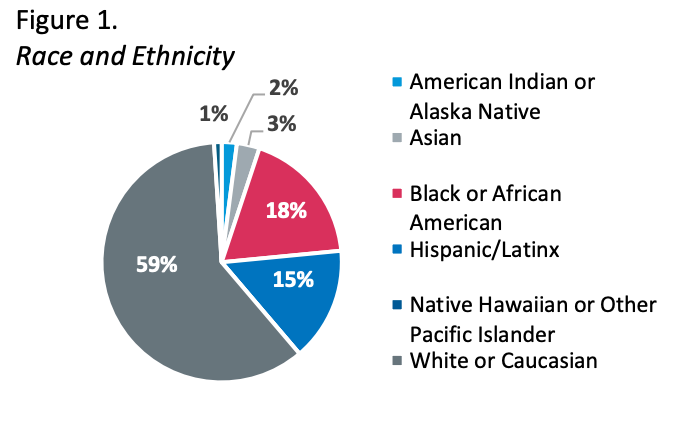
The sample was primarily female (97%) and racially diverse (see Figure 1 for a breakdown of race and ethnicity). The majority of the sample’s ages ranged from 30 to 39 years old (31%); 27% ranged from 40 to 49 years old; 23% ranged from 50 to 59 years old; 8% were 60 or older; and 10% were younger than 29 years old.
Administrators had an average of 17 years of experience in the field (range = 0 – 50, median = 16; SD = 10.02), with an average of 8 years in an administrative position (range = 0 – 43, median = 5, SD = 8.29). Eighty-one percent of the sample had prior experience as an infant, toddler, or preschool teacher. The majority of the sample (86%) held a college degree (see Figure 2). Over half (66%) of those with a degree majored in early childhood education or child development; 25% held a Child Development Associate (CDA); and 33% held an ECE teaching license or certificate. Only 18% of the sample had an administrator credential.
Administrators were asked to report which role best matched their current position. The majority of the sample (51%) selected center director or codirector; 17% selected assistant director; 11% selected executive director; 9% selected owner-director; 4% selected coordinator; 2% selected supervisor; 1% selected school principal; 5% selected other. Twenty percent of the sample reported that their job description also included regularly assigned classroom teaching.
Center-based program administrators were employed in a wide range of programs. Table 1 below provides a detailed breakdown of program characteristics.
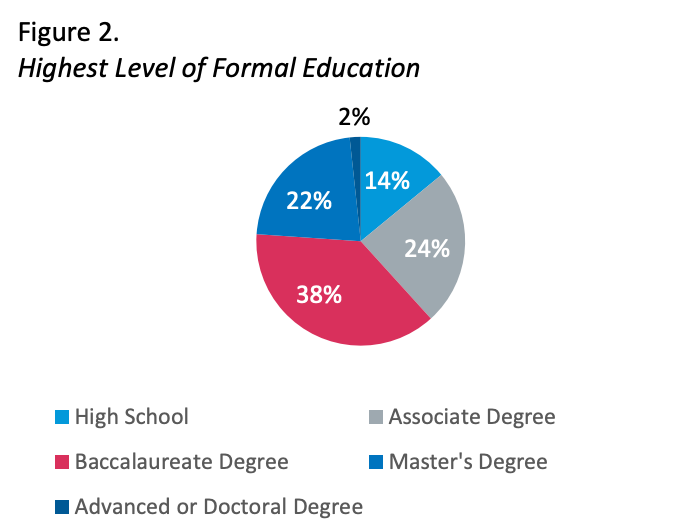
Table 1.
Program Demographics
| Program Characteristics | n | % |
|---|---|---|
| Auspice |
||
| For-Profit |
263 |
41% |
| Nonprofit |
385 |
59% |
| Geographic Location |
||
| Rural |
175 |
27% |
| Urban |
275 |
42% |
| Suburban |
198 |
31% |
| Funding |
||
| Receive Head Start Funding |
119 |
18% |
| Receive Pre-K Funding |
205 |
32% |
| Part of a Multi-Site ECEC Organization |
206 |
32% |
| 2-5 Sites | 121 | 59% |
| 6-19 Sites | 69 |
33% |
| 20-49 Sites | 9 |
4% |
| 50+ Sites | 7 |
3% |
| Extended Program Options |
||
| Evening/Extended |
14 |
4% |
| Overnight |
7 |
2% |
| Ages Served |
||
| Infant (birth-11 months) |
504 |
78% |
| Toddler (12-30 months) |
557 |
86% |
| Preschool (31 months-5 years) |
619 |
95% |
| School-age (5-12 years) |
324 |
50% |
| Nationally Accredited |
216 |
33% |
Measures
Data were collected using the ARPS, an online survey for center-based program administrators (Abel et al., 2019). The ARPS is a self-report assessment that provides information regarding administrators’ internalized practices, levels of self-efficacy, and competencies across the three Whole Leadership domains, and each competence was rated on a 5-point scale (1= I am not confident in my ability to… 5 = I am very confident in my ability to…). The ARPS identifies administrators’ developmental career stages based on the score distribution of their self-perception of mastery of key leadership competencies.
FINDINGS
Analyses of variances (ANOVAs) were used to examine differences in leaders’ self-efficacy across three Whole Leadership domains and eight specific competency areas within Administrative Leadership at three career stages. These analyses offer valuable insights into the developmental progressions in leadership skills and training needs among early childhood administrators.
Stage-related Differences Across Whole Leadership
The ARPS categorizes administrators as novice, proficient, or advanced based on self-identified levels of self-efficacy and competence across key leadership functions (Abel et al., 2019). Across all three Whole Leadership domains, administrator self-efficacy increased consistently and substantially from novice to proficient and proficient to advanced stages (see Table 2). The differences were not marginal. One-way ANOVA revealed statistically significant differences across career stages in every domain (F values ranging from 828.36 to 982.87, p < .001), with effect sizes (η²= .72–.75), indicating that career development stage accounts for approximately 72–75% of the variance in self-efficacy scores across all three domains.
Across the three Whole Leadership Domains, leaders at all three career stages were rated lowest in the Administrative Leadership domain. Moreover, the gap between stages was the largest within Administrative Leadership. Conversely, Pedagogical Leadership was highest among proficient and advanced administrators. This trend is consistent with the fact that many administrators had prior teaching experience. The same pattern was observed with Leadership Essentials.
Table 2.
Means, Standard Deviations, and One-Way Analyses of Variance of Self-Efficacy in Whole Leadership Domains Across Administrator Career Development Stage Whole Leadership Domain M SD
| Whole Leadership Domain | M | SD | Mean Diff | F(2, 645) | η² |
|---|---|---|---|---|---|
| Administrative Leadership |
|||||
| Novice |
2.36 |
0.32 | — | 982.87*** | 0.75 |
| Proficient |
3.00 | 0.25 | 0.65 | ||
| Advanced | 3.72 | 0.23 | 0.72 | ||
| Pedagogical Leadership |
|||||
| Novice | 2.51 | 0.34 | — | 828.36*** |
0.72 |
| Proficient | 3.11 | 0.25 | 0.60 | ||
| Advanced | 3.80 | 0.19 | 0.69 | ||
| Leadership Essentials |
|||||
| Novice | 2.51 | 0.32 | — | 840.83*** |
0.72 |
| Proficient | 3.10 |
0.25 | 0.60 | ||
| Advanced | 3.74 | 0.21 | 0.63 |
Note. Novice n = 237, Proficient n =300, Advanced n = 111. Mean Diff. values represent the difference between adjacent career stages (Novice → Proficient, Proficient → Advanced). *** p <.001. η² = effect size (sum of squares between / total).
Stage-related Differences in Administrative Leadership Competencies
Further analysis revealed significant differences in self-efficacy between career stages on all eight Administrative Leadership competency areas (see Table 3). One-way ANOVAs yielded highly significant Fvalues across every area (p < .001), with effect sizes ranging from η² = .31 (public relations & marketing Expertise) to η² = .61 (human resource development expertise), indicating that career stage explains between 31% and 61% of the variance in self-efficacy across these competency areas. Post hoc GamesHowell tests confirmed significant differences among all three career stage groups, novice, proficient, and advanced, with novices consistently scoring lowest and advanced administrators scoring highest across every competency area.
Table 3.
Means, Standard Deviations, and One-Way Analyses of Variance of Self-Efficacy in Administrative Leadership Competencies Across Administrator Career Development Stage
| dministrative Leadership Competency | M | SD | Mean Diff | F(2, 645) | η² |
|---|---|---|---|---|---|
| Ability to Plan Strategically |
|||||
| Novice |
2.19 | 0.71 | — |
193.72*** |
.38 |
| Proficient |
2.91 | 0.69 | 0.76 |
||
| Advanced | 3.67 | 0.54 | 0.76 |
||
| Cultivate Positive Organizational Climate |
|||||
| Novice | 2.12 | 0.56 |
— |
314.89*** | .49 |
| Proficient | 2.86 | 0.50 |
0.73 | ||
| Advanced | 3.57 | 0.48 |
0.71 | ||
| Human Resource Development Expertise |
|||||
| Novice | 2.37 | 0.43 |
— | 506.72*** | .61 |
| Proficient | 2.98 | 0.38 |
0.61 | ||
| Advanced | 3.77 | 0.28 |
0.79 | ||
| Systems Development Expertise |
|||||
| Novice | 2.36 |
0.68 |
— | 196.14*** | .38 |
| Proficient | 3.04 |
0.61 | 0.68 | ||
| Advanced | 3.73 |
0.49 |
0.69 | ||
| Financial and Legal Knowledge & Skills |
|||||
| Novice | 2.38 |
0.53 |
— | 220.93*** | .41 |
| Proficient | 2.95 |
0.53 |
0.58 | ||
| Advanced | 3.61 | 0.48 |
0.66 | ||
| Public Relations & Marketing Expertise |
|||||
| Novice | 2.86 |
0.73 |
— | 146.88*** | .31 |
| Proficient | 3.46 |
0.55 |
0.60 | ||
| Advanced | 3.95 |
0.21 |
0.50 | ||
| Public Engagement Skills |
|||||
| Novice | 2.49 |
0.77 |
— | 177.69*** | .36 |
| Proficient | 3.19 |
0.63 | 0.70 | ||
| Advanced | 3.85 |
0.39 |
0.66 | ||
| Talent Development |
|||||
| Novice | 2.31 |
0.65 |
— | 249.27*** | .44 |
| Proficient | 2.90 |
0.55 |
0.59 | ||
| Advanced | 3.78 |
0.46 |
0.88 |
Note. Novice n = 300, Proficient n =300, Advanced n = 111. Mean Diff. values represent the difference between adjacent career stages (Novice → Proficient, Proficient → Advanced). *** p <.001. η² = effect size (sum of squares between / total).
The largest self-efficacy gaps between novice and proficient administrators appeared in strategic planning, organizational climate cultivation, and public engagement, while gaps between proficient and advanced groups were greatest in strategic planning, human resources expertise, and talent development. It is also worth noting that public relations and marketing expertise had the highest novice mean (M = 2.86) and the smallest effect size (η² = .31), suggesting that administrators enter the field with relatively stronger confidence in this area than in others. However, meaningful growth across stages remains evident.
IMPLICATIONS
The findings of this study offer a clear, actionable message for those who design, deliver, and fund professional learning for center-based program administrators: the career development stages matter enormously.
Across career stages, one overarching finding stands out for its consistency: self-efficacy increases significantly and systematically from novice to proficient to advanced across all three Whole Leadership domains (Administrative Leadership, Pedagogical Leadership, and Leadership Essentials).
Within the Administrative Leadership domain, the pattern of competency-specific gaps across career stages points to concrete priorities for professional learning at each stage. For novice administrators, the largest gaps relative to their proficient peers were in strategic planning, cultivating organizational climate, and public engagement. These are not peripheral skills; they are foundational to building and sustaining a high-quality program. An administrator who lacks confidence in strategic planning may struggle to set a coherent vision for their program; one who feels underprepared to cultivate a healthy organizational climate may find it difficult to retain staff or build a positive workplace culture. The fact that novices report the greatest deficits in these areas underscores the need for onboarding and early-career professional learning that goes beyond operational basics to address the relational and strategic dimensions of leadership.
For proficient administrators, the largest gaps in Administrative Leadership relative to advanced administrators were in talent development, human resource development, and strategic planning. These competency areas reflect a shift from managing day-to-day operations effectively to building long-term organizational capacity, such as developing people and cultivating leadership in others. This suggests that mid-career professional learning should not only reinforce existing strengths but also stretch administrators toward higher-order, systems-level thinking. Additionally, advanced administrators may require targeted and continued support and development in organizational climate, as well as financial and legal competencies.
The talent development jump from proficient to advanced (Δ = 0.88) is the single largest mean difference and stands out as particularly noteworthy. Additionally, the area of human resource development expertise had both the largest effect size (η² = 0.61) and a very large proficient-to-advanced gap. In other words, administrators appear to show the steepest growth in people-focused competencies as they move from proficient to advanced, suggesting that investing in and growing others may be a hallmark of advanced leadership.
Taken together, these findings make a compelling case for stage-differentiated professional development for ECEC center administrators. Professional learning content creators, coaches, and technical assistance providers can use career stage as a primary organizing principle when developing learning experiences and sequencing leadership content. The Whole Leadership Framework provides the map of what administrators need to know and do; this study's findings illuminate where, on that map, administrators at each stage currently stand and where they most need to go.
Certain limitations should be considered when interpreting this study. The ARPS relies on administrators' self-perceptions of competency mastery and self-efficacy, which may not fully reflect actual performance. The sample, while national in scope across 23 states, was not randomly selected, limiting generalizability. Additionally, the cross-sectional design captures differences between career stages at a single point in time rather than tracking administrator growth longitudinally, which means differences across stages are descriptive rather than causal. Future research employing longitudinal designs and multiple measures of competency would strengthen and extend these findings.
REFERENCES
Abel, M., Bella, J., Talen, T., & Magid, M. (2019). Administrators' Role Perceptions Survey validation study: Technical report. McCormick Center for Early Childhood Leadership, August 2019.
Abel, M. B., Talan, T. N., & Magid, M. (2018). Closing the leadership gap: 2017 status report on early childhood program leadership in the United States. McCormick Center for Early Childhood Leadership, National Louis University.
Bella, J., Abel, M., Bloom, P.J., & Talan, T. (2017). Administrator Role Perception Survey. McCormick Center for Early Childhood Leadership, National Louis University.
Bloom, P. J., & Bella, J. (2005). Investment in leadership training: The payoff for early childhood education. Young Children, 60(1), 32–40.
Bloom, P. J., Jackson, S., Talan, T. N., & Kelton, R. (2013). Taking Charge of Change: A 20-year review of empowering early childhood administrators through leadership training. McCormick Center for Early Childhood Leadership, National Louis University.
Dall’Alba, G., & Sandberg, J. (2006). Unveiling professional development: A Critical review of stage models. Review of Educational Research, 76(3), 383–412.
Doherty, G., Ferguson, T. M., Ressler, G., & Lomotey, J. (2015). Enhancing child care quality by director training and collegial mentoring. Early Childhood Research and Practice, 17(1).
Douglass, A. (2019). Leadership for quality early childhood education and care. OECD Education Working Papers, N 211. OECD Publishing.
Dreyfus, H. L., & Dreyfus, S. E. (1986). Mind over machine: The power of human intuition and expertise in the era of the computer. New York Free Press.
Ehrlich, S. B., Pacchiano, D., Stein, A.G., & Wagner, M.R. (2018). Early education essentials: Validation of surveys measuring early education organizational conditions. Early Education and Development, 30(2), 1–28.
Fukkink, R. & Lont, A. (2007). Does training matter? A meta-analysis and review of caregiver training studies. Early Childhood Research Quarterly, 22. 294–311.
Kelton, R., & Talan, T. N. (2023). We can’t afford to lose leaders: Professional development to increase administrator retention during the first few years. Research Notes. McCormick Center for Early Childhood Leadership, National Louis University.
Kinchin, I. M., & Cabot, L. B. (2010). Reconsidering the dimensions of expertise: from linear stages towards dual processing. London Review of Education, 8(2), 153–166.
McCormick Center for Early Childhood Leadership. (2018). Directors’ professional development needs differ by developmental stage. Research Notes. National Louis University.
McCormick Center for Early Childhood Leadership. (2017). Whole Leadership Framework for early childhood programs. National Louis University.
McCormick Institute for Early Childhood (2026). Whole Leadership Framework for early childhood programs. National Louis University.
Rafanello, D. & Bloom, P. (1997, August). The 1997 Illinois Directors’ Study. A Report to the Robert R. McCormick Foundation.
Sims, M., Forrest, R., Semann, A., & Slattery, C. (2014). Conceptions of early childhood leadership: driving new professionalism? International Journal of Leadership in Education, 18(2), 149–166.
Talan, T. N., Bloom, P. J, & Kelton, R. (2014). Building the leadership capacity of early childhood directors: An evaluation of a leadership development model. Early Childhood Research & Practice, 16.
Whitebook, M., Phillips, D., & Howes, C. (2014). Worthy work, STILL unlivable wages: The early childhood workforce 25 years after the National Child Care Staffing Study. Center for the Study of Child Care Employment, UC Berkeley.